How Much Does an AI System Cost for a Trades Business?
A working AI system for a trades business costs between $500 and $2,500 to build and $50 to $200 per month to run. That’s a system that answers calls, qualifies leads, and books jobs. At the low end, you’re getting a phone agent that never misses a call. At the high end, you’re getting a fully integrated system that handles dispatching, follow-up, and customer re-engagement. Either way, the number is smaller than one missed emergency call per month.
Those numbers are real. Not estimates from a pricing page. They come from systems we’ve actually built for trades businesses — HVAC shops, plumbing contractors, electrical firms — where the ROI math is the same every time: the system pays for itself the month it recovers the jobs your voicemail is eating.
The Two Builds: Quick-Win vs. Full System
Most trades owners don’t need to boil the ocean. They need to stop losing money on one specific leak. Here’s what both paths actually look like.
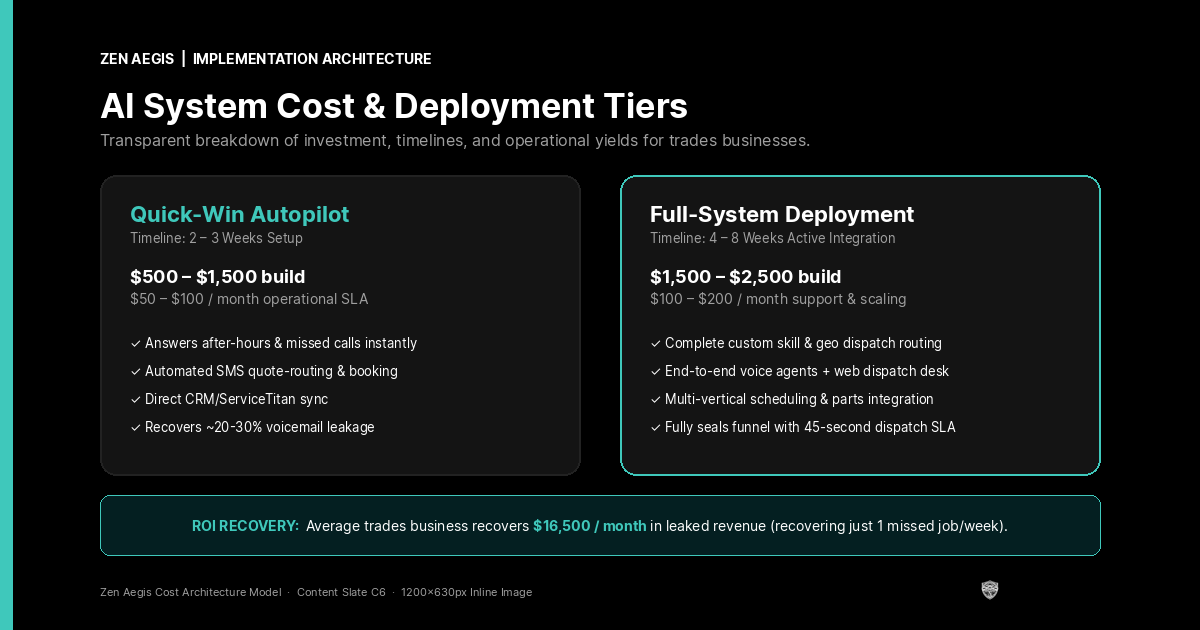
The Quick-Win Build ($500–$1,500 build / $50–$100/month)
This is a single-workflow system. Pick the one thing bleeding the most revenue — for most trades businesses, it’s missed calls — and build a system that handles that workflow end to end.
What it typically includes:
- An agent that answers inbound calls, captures the job details, and books the appointment — no voicemail, no “I’ll call you back”
- Quote generation from a simple rules engine (your pricing, your service categories, your availability windows)
- Automated follow-up: confirmation texts, reminder messages, post-job review requests
- A dashboard showing calls handled, jobs booked, and revenue captured
Time to live: 2–4 weeks. The month-one ROI is usually obvious — count the calls that would have hit voicemail, multiply by your average job value, and you’ve got your number. If you’re currently losing two calls a week to voicemail, and the industry average is 20–30% of inbound going unanswered, a $500 build and $79/month run cost is covered by recovering one average job. Everything above that is margin.
The Full System ($1,500–$2,500 build / $100–$200/month)
This connects the front and back of the business. The phone agent isn’t a standalone tool — it feeds into dispatch, which feeds into quoting, which feeds into follow-up. Every handoff that used to be a text message, a sticky note, or a “hey did you call that guy back” becomes a system step.
What it typically includes:
- Everything in the quick-win build, plus:
- Intelligent dispatch — the system routes jobs based on technician location, skill set, and availability
- Dynamic quoting that adjusts for parts pricing, travel time, and job complexity
- Full customer lifecycle: quote → job → invoice → review request → re-engagement campaigns
- Integration with your existing CRM or job management software (ServiceTitan, Housecall Pro, Jobber — we build the connective tissue)
Time to live: 6–10 weeks. A full system costs more because it touches more of your operation. But it also recovers more. Most trades businesses running a full system find the missed-call recovery alone covers 3–5x the monthly cost, before factoring in the follow-up revenue from quotes that would have died in a text thread.
The Missed-Call Recovery Math
This is the frame that makes the cost conversation irrelevant for most owners. Here’s why.
The average trades business loses 20–30% of inbound leads to voicemail. Not bad leads. Paying customers who called ready to book — and got a recording. Some leave a message. Most don’t. They call the next guy.
Run the numbers on a mid-size shop:
| What’s Leaving | Monthly |
|---|---|
| Inbound calls/month | 200 |
| Calls that hit voicemail (~25%) | 50 |
| Voicemails that actually leave a message | 15–20 |
| Jobs lost to unanswered calls | 30–35 |
| Average job value | $400 |
| Revenue lost/month | $12,000–$14,000 |
The AI system that catches those calls costs $79/month. It doesn’t need to recover all of them to justify itself. It needs to recover one call per month. The rest is profit. The ROI frame that actually matters: an AI phone agent costs less per month than the revenue from a single recovered service call. Everything above that is upside you’re currently leaving on the table. The booking accuracy. The follow-up. The 3 AM emergency that gets routed instead of going to voicemail.
That’s the quick-win build. The full system compounds from there.
What Changes the Price
Four things move the needle on cost — and they matter more than whether you pick quick-win or full-system.
1. How many workflows you’re automating. One workflow (missed calls) is the quick-win. Three workflows (calls + dispatch + follow-up) is the full system. Every additional workflow adds scope — but the marginal cost drops as you go because the infrastructure is already built.
2. Integration complexity. If your shop runs on ServiceTitan or Housecall Pro, we build the connective layer — the system talks to what you already use. If you’re running on notebooks and text chains, we build the system from scratch. The latter costs more upfront but gives you something you actually own.
3. How fast you need it. 2–4 weeks for a quick-win is standard. If you need it in a week, it costs more — not because the work is harder, but because we dedicate more of our team to your build simultaneously.
4. Ongoing tuning and expansion. The monthly run rate isn’t just hosting and maintenance. It’s us operating the system — tuning the models as they improve, adjusting the workflows as your business changes, and staying accountable to whether it’s still working. That’s the difference between a vendor who hands you the keys and an operating partner who stays in the building.
FAQ
Is there a contract?
No. We operate month to month. If the system stops being worth it, you stop paying. We build it that way because we’re confident the ROI holds — and because a contract doesn’t fix a system that isn’t working.
How long until it’s live?
A quick-win build — single workflow, like missed-call recovery — takes 2–4 weeks from kickoff to live. A full system is 6–10 weeks. You’ll see the first working prototype within 7–10 days either way.
Do I need to replace my current software?
No. If you’re already running ServiceTitan, Housecall Pro, Jobber, or a similar platform, we build the layer that connects to it. The AI system sits on top of what you’ve got — it doesn’t ask you to rip anything out.
Who owns what we build?
You do. The system, the data, the workflows — they’re yours. We operate it, tune it, and keep it running, but the IP belongs to your business. If we ever part ways, you keep everything.
What if my team doesn’t want to use it?
That’s the deployment problem, not the technology problem — and it’s the reason most AI implementations fail. We don’t hand you a dashboard and walk away. We work with your team during rollout, prove the system on live jobs, and stay until it’s part of how the business actually runs. The technology is the easy part. The human transition is the work.
Can I start with a quick-win and expand later?
That’s the path we recommend. One workflow, proven ROI, then expand. Most of our trades clients start with missed-call recovery and add dispatch and follow-up within 60–90 days — once they’ve seen the numbers.
What does the free POC look like?
We build a working prototype of your system — on your workflow, with your pricing, handling your actual call scenarios. Not a slide deck. Not a demo environment. A working piece of your business. It takes about a week. No commitment, no cost. You see the system handle real calls before you decide anything.
Ready to see what a system built for your shop actually looks like? Get a free POC →
Related Reading
Why 95% of AI Initiatives Show Zero ROI — And What the First 60 Days Should Look Like Instead →
Most AI initiatives fail. Not because the technology doesn’t work, but because nobody changed how the humans work. This practical guide breaks down the first 60 days of real-world transformation.
More on how we work with trades businesses: Our Approach to AI Systems →
Stop collecting AI tools. Start deploying systems that do the work.
Want a sharper operating system than another chatbot subscription?
We design AI systems around the work your team actually needs done: strategy, research, delivery, follow-through, and execution that moves revenue.