Fractional Leadership + AI: The Secret Sauce for Tech Companies Ready to Break Through
The Growth Dilemma Tech Companies Face in 2025
Tech companies today face a unique paradox: they need high-caliber leadership and cutting-edge AI capabilities to break through market barriers, but acquiring both traditionally requires massive investment that can drain the very resources needed for growth.
The most ambitious tech companies are discovering a powerful solution: pairing fractional leadership with strategic AI implementation. This combination provides the executive-level guidance and technological advantage of much larger organizations—without the prohibitive costs and commitment of full-time C-suite hires or massive tech investments. Learn more about fractional CRO vs full-time CRO analysis.
At Zen Aegis, we’ve witnessed this partnership model transform struggling tech companies into market leaders. Here’s why this approach works so well in today’s competitive landscape.
What Exactly Is Fractional Leadership?
Fractional leadership isn’t just another buzzword—it’s a fundamental shift in how companies access executive talent. Unlike traditional consultants who advise from the sidelines, fractional leaders actually join your team in an executive capacity, but at a fraction of the time and cost.
A fractional leader might be your:
- Chief Technology Officer driving product development 2 days per week
- Chief Marketing Officer building your growth strategy 10 days per month
- Chief Revenue Officer optimizing your sales funnel on a quarterly basis
The key difference? They’re not just advisors—they’re embedded partners with skin in the game, making decisions and taking responsibility for outcomes just like any other executive team member.

Why Tech Companies Particularly Benefit
Tech companies face unique challenges that make fractional leadership especially valuable:
- Rapid innovation cycles require diverse expertise at different growth stages
- Highly specialized leadership skills (AI implementation, cybersecurity, data governance) are prohibitively expensive when hired full-time
- Funding constraints mean startups and scale-ups must maximize every dollar
- Competitive talent markets make recruiting full-time executives a lengthy, uncertain process
As one founder told us: “Hiring a full-time CTO would have cost us $250,000+ annually plus equity—resources we simply didn’t have. Our fractional CTO delivered the same expertise for less than a third of that cost, while helping us build an in-house team gradually.”
The AI Advantage in Modern Business
While fractional leadership addresses the human talent equation, AI solves the scalability and efficiency challenges tech companies face.
The AI landscape has matured significantly in 2025. We’re well beyond the hype cycle and into practical implementation that delivers real ROI. Today’s AI tools:
- Automate routine decisions using historical data patterns
- Enhance human capabilities through intelligent assistants and augmentation
- Identify opportunities and risks by processing vast amounts of market data
- Personalize customer experiences at scale without ballooning operational costs
For tech companies specifically, AI now powers everything from code quality assurance to predictive maintenance, customer support to complex market analysis. The companies breaking through in 2025 aren’t just using AI—they’re strategically integrating it into their core operations.
The Synergy: Why Fractional + AI Creates Magic
When fractional leadership and AI implementation come together, something remarkable happens. This combination creates what we call “asymmetric advantage”—the ability to compete far above your weight class.
Here’s why this pairing works so powerfully:
1. Experience Meets Innovation
Fractional leaders typically bring 15+ years of executive experience navigating technology shifts. They’ve seen AI hype cycles come and go, giving them the wisdom to identify which AI implementations will actually move the needle for your specific business.
As one client shared: “Our fractional CRO knew exactly which parts of our sales process would benefit from AI automation and which needed the human touch. We ended up increasing conversions by 32% while actually reducing our tech stack costs.”
2. Cost-Effective Transformation
The traditional path to AI transformation is expensive:
- Hire a full-time executive: $200-300K+ annually
- Bring in a big consulting firm: $500K+ for recommendations
- Build an in-house AI team: $1M+ annually
The fractional + AI approach delivers similar or better results at a fraction of the cost:
- Fractional executive: $8-15K monthly for active leadership
- Targeted AI implementations: $5-20K per solution
- Gradual capability building: Knowledge transfer to your existing team

3. Speed and Agility
Tech markets move incredibly fast. The fractional + AI approach dramatically accelerates:
- Decision cycles: Experienced fractional leaders make confident decisions quickly
- Implementation timelines: Pre-built AI solutions deploy in weeks, not months
- Learning curves: Your team gains knowledge transfer from experts who’ve done it before
- Iteration speed: The combination of human insight and AI processing power enables rapid testing and refinement
4. Balanced Implementation
Perhaps most importantly, this combination brings balance. AI without expert guidance leads to expensive experiments and “shiny object syndrome.” Leadership without AI tools means manual scaling that eventually hits a wall.
Together, they create the perfect balance of vision and execution. Your fractional leader ensures AI implementations align with business strategy, while AI tools extend the impact of your leadership team far beyond what would be possible manually.
Real-World Success Stories
This isn’t theoretical—we’ve seen this combination transform tech companies across sectors:
Case Study: B2B SaaS Platform
A promising SaaS company had a solid product but struggled with lengthy sales cycles and high customer acquisition costs. By bringing in a fractional CRO and implementing AI-powered lead scoring and nurturing, they:
- Reduced sales cycles by 47%
- Decreased CAC by 36%
- Increased conversion rates by 28%
- All while reducing their overall marketing budget
Case Study: FinTech Startup
A fintech startup needed to scale rapidly after securing Series A funding but couldn’t afford a full C-suite. Their solution? A fractional CTO three days weekly combined with AI-powered customer service and fraud detection systems. The results:
- Successfully launched four new product features in six months
- Maintained 99.98% service uptime during 5x user growth
- Kept fraud rates below 0.1% despite expanding to new markets
- Achieved all this with a technology team of just seven people
Implementation Roadmap: How to Get Started
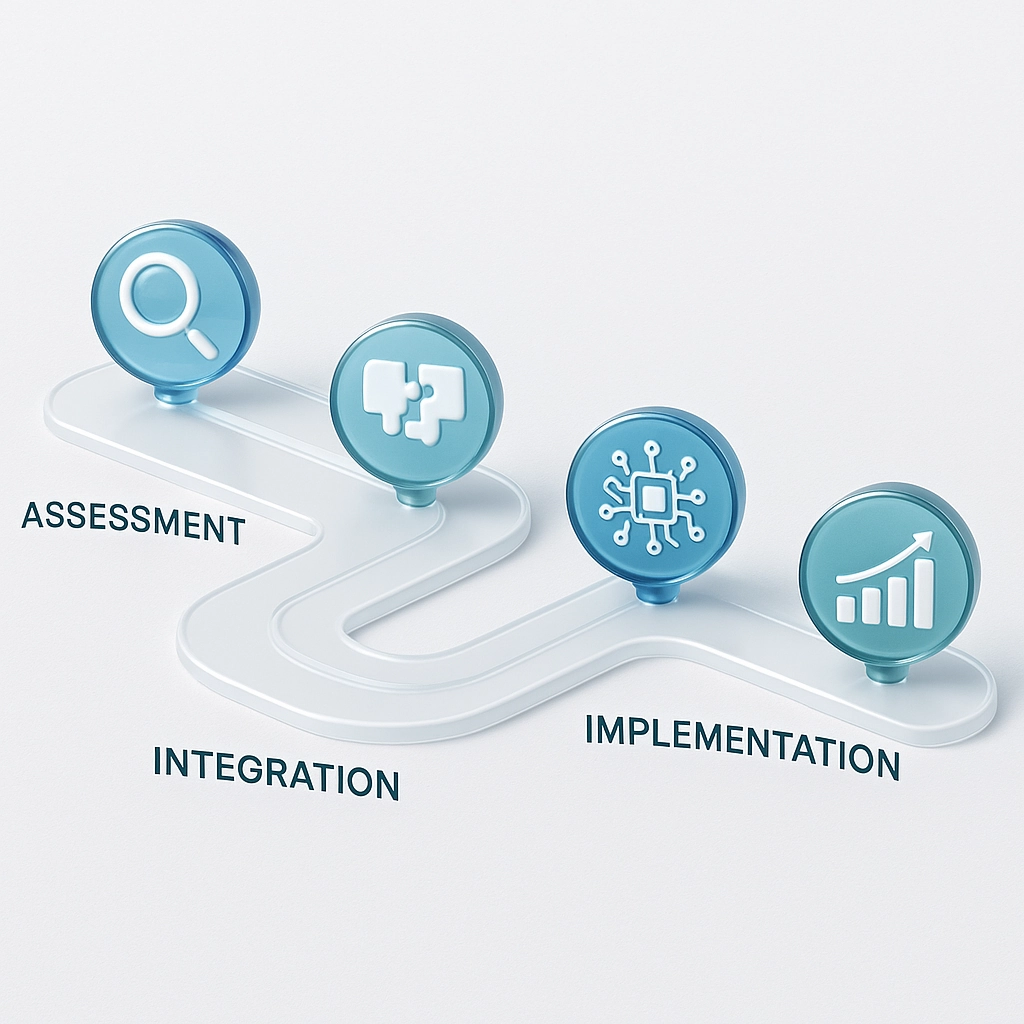
If you’re considering this approach for your tech company, here’s a proven roadmap we’ve developed with our partners:
Phase 1: Assessment (Weeks 1-2)
- Evaluate current leadership gaps and capabilities
- Identify high-impact areas for AI implementation
- Define clear success metrics and outcomes
Phase 2: Leadership Integration (Weeks 3-4)
- Bring in the right fractional executive(s) for your specific needs
- Establish communication protocols and decision rights
- Integrate with existing team members to ensure alignment
Phase 3: Strategic AI Implementation (Months 2-3)
- Prioritize AI initiatives based on potential impact and feasibility
- Begin with quick wins to build momentum and demonstrate value
- Develop governance frameworks for responsible AI deployment
Phase 4: Optimization and Scaling (Months 4-6)
- Measure results against initial benchmarks
- Refine approaches based on real-world performance
- Gradually build internal capabilities through knowledge transfer
- Scale successful implementations across other business areas
Common Challenges and How to Overcome Them
This approach isn’t without challenges. Here are the most common ones we see and how to address them:
Challenge 1: Resistance from existing team members
Solution: Clearly communicate that fractional leaders are partners who amplify the team’s capabilities, not replacements. Involve key team members in the selection process.
Challenge 2: AI implementation exceeding budget or timeline
Solution: Start with smaller, well-defined AI projects before tackling complex transformations. Establish clear success criteria and stopping points.
Challenge 3: Integration issues between systems
Solution: Begin with a thorough technical assessment before implementation. Prioritize solutions that work with your existing tech stack.
Challenge 4: “Too many cooks” syndrome with multiple fractional leaders
Solution: Establish clear decision rights and areas of responsibility. Consider having one fractional leader coordinate if you’re bringing in multiple specialists.
The Path Forward: Is This Right for Your Company?
The fractional leadership + AI approach isn’t right for every company. It works best for:
- Growth-stage tech companies needing to scale expertise faster than headcount
- Established companies facing digital transformation challenges
- Resource-constrained organizations that need executive-level talent but can’t justify full-time C-suite salaries
- Companies in rapidly evolving sectors where staying current on technology is business-critical
If you recognize your organization in those descriptions, this combination could be the breakthrough approach you’ve been searching for.
Conclusion: The Competitive Edge You Need
In 2025’s tech landscape, the companies breaking through aren’t necessarily the ones with the biggest budgets or the most employees. They’re the ones strategically combining high-caliber leadership with cutting-edge technology.
The fractional leadership + AI model gives you access to executive expertise that would otherwise be out of reach, alongside technology implementations that multiply your team’s impact. It’s not about replacing people—it’s about empowering them to accomplish more than they thought possible.
At Zen Aegis, we don’t just advise—we partner. Our fractional leadership approach means we’re in the trenches with you, taking responsibility for outcomes while transferring knowledge to your team. Combined with our strategic AI implementation services, we help tech companies break through barriers that once seemed insurmountable. Learn more about our leadership services.
Ready to explore how this powerful combination could transform your tech company? Learn more about our approach or contact us to start a conversation about your specific challenges. how we deploy AI for growth.
Stop collecting AI tools. Start deploying systems that do the work.
Want a sharper operating system than another chatbot subscription?
We design AI systems around the work your team actually needs done: strategy, research, delivery, follow-through, and execution that moves revenue.