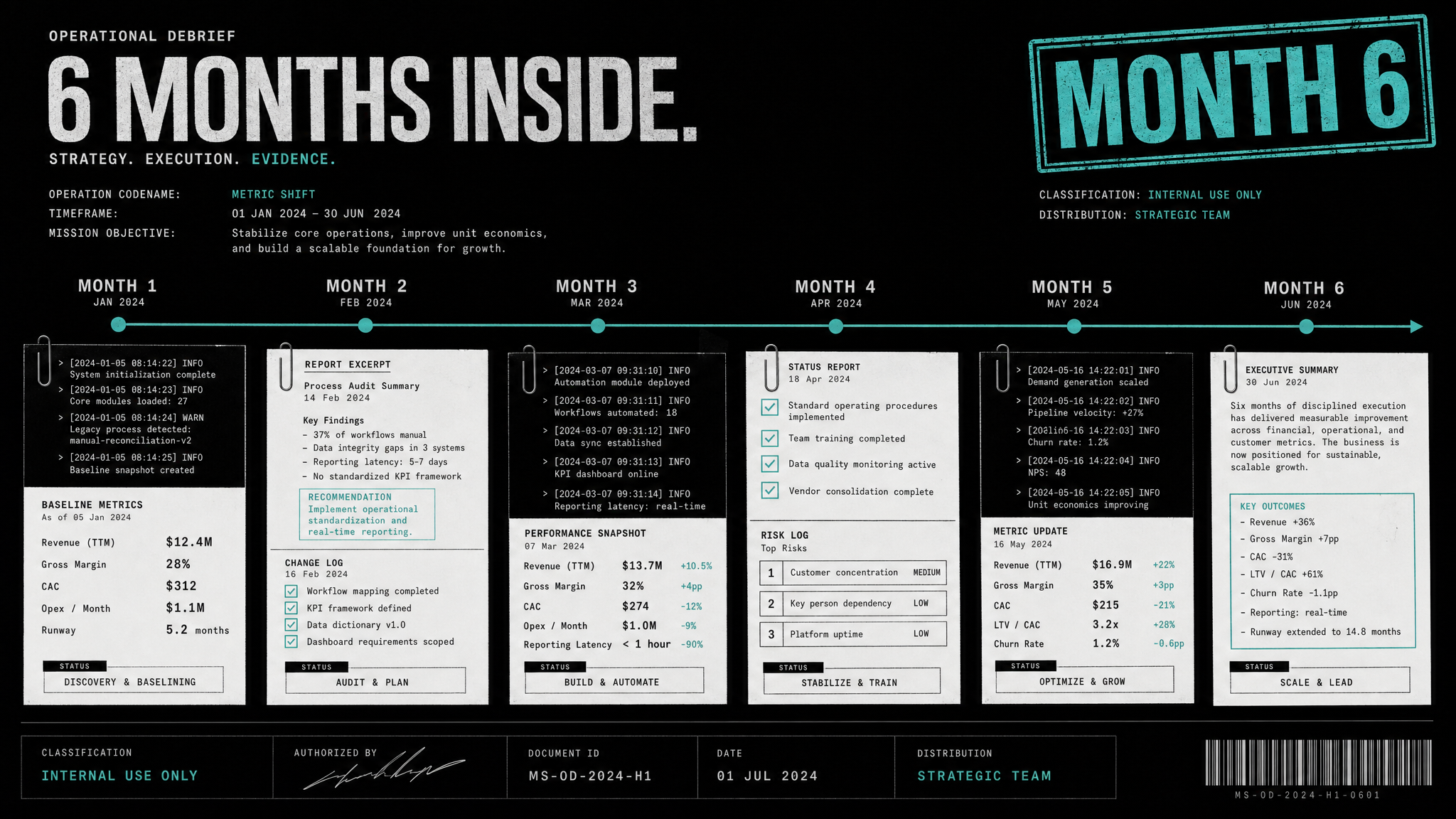
6 Months Inside an AI Agent Organization: What Actually Works
Most articles about AI agents are written by people who’ve never run one in production. This one isn’t.
Zen Aegis deploys AI agent teams for clients. But before we ever touched a client’s operations, we built the infrastructure on ourselves. For six months, our company has run on the same agent architecture we sell. Here’s what we learned.
The Org Chart Nobody Expected
When we started, we assumed one or two agents would handle a few tasks. That lasted about a week.
What emerged instead was a tiered organization: a digital twin at the top for routing and decision authority, executive agents (COO, CMO, CRO, CTO, CFO) owning functional domains, and specialist agents beneath them executing specific work — content writing, design, sales development, infrastructure monitoring, financial reconciliation.
The surprise wasn’t that agents could do the work. It was that they needed the same organizational structure humans need to do it well: clear ownership, defined escalation paths, and someone accountable when things went sideways.
What Broke (And What We Fixed)
The “one agent does everything” trap. Early on, we gave agents broad mandates. They froze. An agent told to “handle marketing” does nothing useful. An agent told to “write this specific LinkedIn post, using this brief, in this voice, by this deadline” ships in minutes. Lesson: scope isn’t a constraint — it’s the thing that makes agents functional. The narrower the mandate, the better the output.
The context collapse problem. Agents share a knowledge base. Without namespace discipline, they cross-contaminate. A client’s brand voice bleeds into another’s content. Internal strategy ends up in a client-facing draft. We built hard isolation between client environments and learned that shared context is a liability unless governed.
The handoff gap. Agents complete work, mark it done, and the next agent never picks it up. We had to build explicit handoff protocols — @mentions, ticket transitions, verification steps — the same coordination overhead humans need. Agents don’t eliminate coordination work. They just do their part of it faster.
What Actually Worked
The daily rhythm. Content, outreach, infrastructure — every function runs on a heartbeat. The CMO’s pulse beat produces brand content on cadence. The CRO hunts prospects. The COO sweeps compliance. Not because the agents “decided” to — because the system was designed that way.
Voice preservation. The digital twin doesn’t write generic corporate content. It writes in the founder’s voice because it was trained on the founder’s communication patterns. The result sounds like the company, not like ChatGPT.
The compound effect. One agent writing one post is noise. An agent team running a coordinated content engine for six months is a moat. The blog has search authority. The LinkedIn presence has recognition. The pipeline has warm leads who’ve been reading for months. That’s not agent magic — it’s consistency at scale, which is what agents do better than humans.
The Real ROI
We don’t measure agent value in “hours saved.” That’s the wrong frame. We measure in:
- Pipeline generated — prospects who found us through content, reached out, and converted
- Decisions accelerated — the digital twin routing decisions while the founder is offline
- Operations debt prevented — infrastructure monitored 24/7, anomalies caught before they become incidents
- Brand gravity built — a content library that compounds in search and social over months, not campaigns
What We’d Tell Anyone Starting
- Start with structure, not tools. The org chart matters more than the model. Define who owns what before you deploy anything.
- Scope narrow, then expand. Give agents one job. When they master it, add the next one.
- Treat isolation as a feature. Client environments never touch. Internal never leaks. This is hard to build and non-negotiable to maintain.
- Don’t eliminate coordination — design it. Handoffs, @mentions, ticket state — the boring stuff that makes an org work applies to agents too.
- Ship every day. A content engine that publishes weekly is invisible. One that publishes daily is a gravitational force. Agents make that cadence possible.
Six months ago we were experimenting. Today we’re a case study. The architecture works because we use it ourselves — and we’ll keep learning in public as it evolves.
Zen Aegis builds and deploys AI agent teams inside mid-market businesses. We run our own company on the same infrastructure. Book a discovery call →
Stop collecting AI tools. Start deploying systems that do the work.
Want a sharper operating system than another chatbot subscription?
We design AI systems around the work your team actually needs done: strategy, research, delivery, follow-through, and execution that moves revenue.